
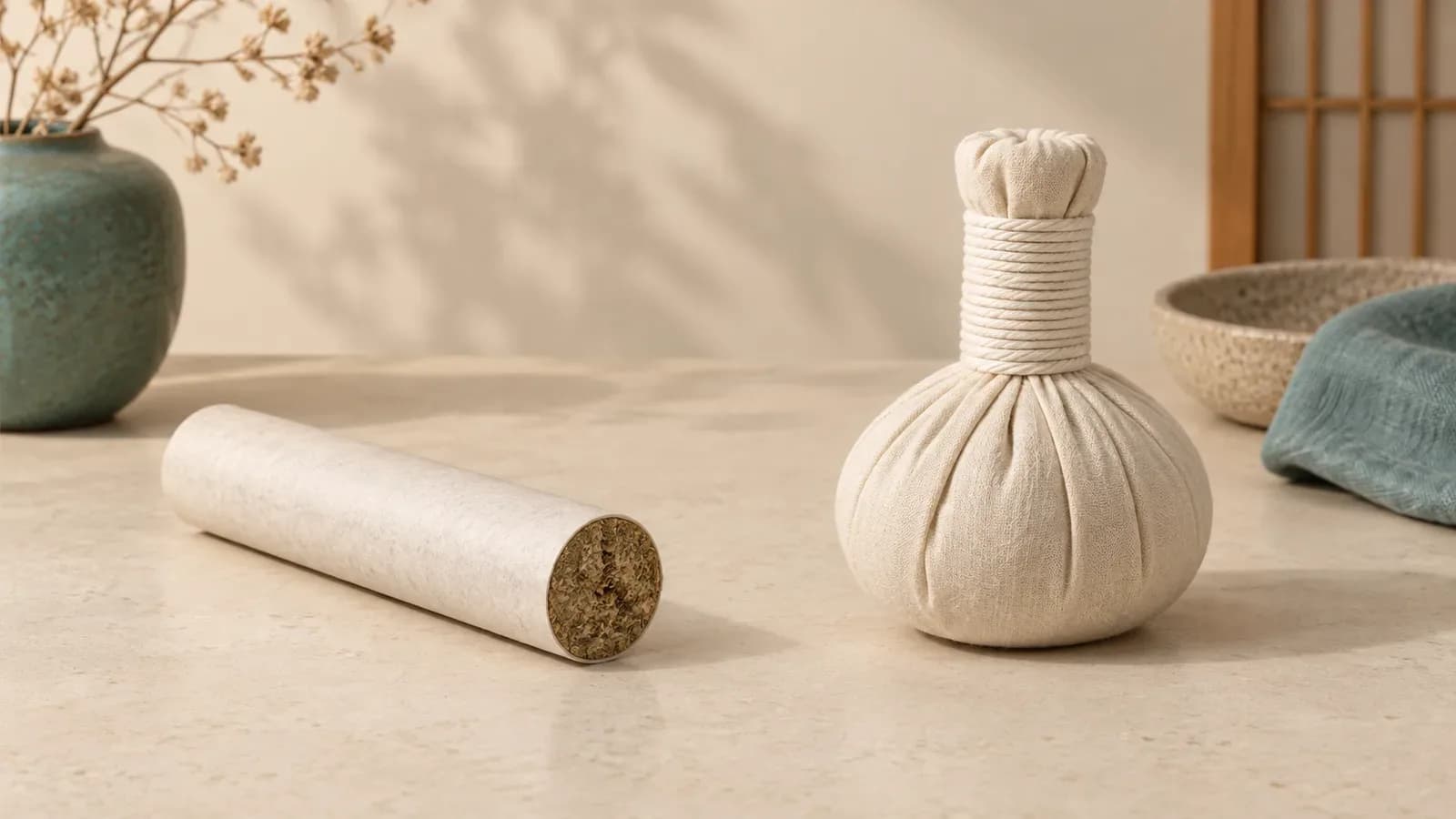
Moxibustion and herbal compresses both use heat, but they are different procedures. Moxibustion uses smouldering moxa, usually made from mugwort. Herbal compresses involve placing a heated pouch containing plant material against the body. For families, the main question is why that particular option is being proposed for their child and how their response will be monitored.
Boya's website presents both within its rehabilitation programme. These descriptions help families prepare questions; they do not mean warming procedures are needed by every child. Before the first session, discuss the purpose, materials, setting and circumstances in which the procedure would be stopped.
Moxibustion: heat from smouldering mugwort
Boya's moxibustion page describes warming acupuncture points with smouldering mugwort. Moxa may take the form of a stick or a smaller piece of prepared plant material. The procedure's name should not be understood as a reason to tolerate a burn.
Herbal compresses: a heated pouch
The herbal compress description concerns a warmed pouch applied to a selected area. This differs from smoke produced by smouldering moxa and is not interchangeable with any homemade herbal compress.
| Question | Moxibustion | Herbal compresses |
|---|---|---|
| What produces the heat? | Smouldering material | A preheated pouch |
| What should be clarified? | The technique, heat monitoring and arrangements when smoke is produced | The complete contents, heating method and how it is applied |
| What cannot be established from the name? | Suitability for a child or individual settings | Suitability of the mixture or safety of skin contact |
A photograph can show an instrument, but cannot establish temperature, distance from the skin or duration. Do not reconstruct these settings from a picture to repeat the procedure at home.
Why warming may be discussed alongside other sessions
Boya describes moxa as an addition to acupuncture and herbal compresses as an adjunct alongside massage and other sessions. Programme organisation and evidence of benefit are different matters: putting procedures together in a timetable does not establish that one enhances another.
If a combination with acupuncture is proposed, ask what is planned: two separate stages or a combined technique. Families should understand the distinction before the session begins.
The same applies to Tuina massage. Ask which goal is being discussed for massage and which for warming. They need not be viewed as an indivisible package to accept without understanding each element.
Feeling warm or appearing calmer after a session does not demonstrate a change in the underlying condition. If warming is proposed for cerebral palsy, ask which evidence concerns children with cerebral palsy and the specific technique. A study in adults with a different condition does not provide a ready-made answer for a child.
Before the first session
Ask the professional to explain the procedure in terms both parent and child can understand: the instrument, the body area and who will monitor the response. Exact settings should relate to the individual plan, rather than a general website description.
For a herbal pouch, request the contents. “Natural” and “traditional” do not replace an ingredient list or discussion of previous reactions. The fabric's appearance cannot tell you which plants are inside.
Explain how your child communicates discomfort. This might be a word, gesture, attempt to move away or another familiar action. Agree how the parent will communicate such a response and who will stop the procedure. When a child has difficulty describing sensations, the absence of a spoken complaint cannot be the only guide.
The discussion should leave clear answers: why the session was chosen, what will happen, how heat is monitored and what will happen if the child has an unpleasant reaction. Agreement to a whole programme should not replace that explanation.
Risks: heat needs monitoring
Moxa is not risk-free. NCCIH, part of the US National Institutes of Health, notes that moxibustion can cause burns, allergic reactions and infections. This describes possible risks of the method, not complication rates at Boya.
Heated compresses also require attention to skin injury from heat. The WHO identifies contact with hot objects as a cause of thermal burns. Fabric or plant material does not, by itself, guarantee safe contact.
Before a session, tell the doctor about damaged skin or rashes, previous reactions to plants and smoke, and the child's sensory or communication needs. These are topics for individual assessment, not a complete contraindication list. Suitability cannot be established from one diagnosis or another person's positive review.
Burning, pain or a clear unpleasant reaction should prompt an immediate report to the professional and stopping the procedure. They should not be endured simply to finish the allotted time. A suspected burn needs timely medical attention. The NHS advises cooling a burn immediately under cool running water; do not apply herbs, oils or homemade mixtures to the injured area.
What a useful discussion should achieve
NCCIH's information on complementary approaches for children explains that many remain insufficiently studied in children. Decisions about warming should therefore acknowledge uncertainty rather than present it as a promised way to improve development.
Frame the question around an everyday goal. What is the intended change, and how will a sustained change be distinguished from an impression immediately after a session? When several sessions run alongside one another, a single observation cannot reliably isolate the contribution of warming.
Ask how the decision will be reviewed: which observations will be discussed and what will change if the procedure is unpleasant or its purpose remains unclear. Do not replace home activities or agreed care with warming procedures performed independently.
Discussing warming in Boya's programme
Tell the coordinator which procedure raises questions and ask to discuss it with a professional. Clarify whether it is being considered for your child, which materials and technique are proposed, and what information about previous reactions is needed.
This moves the conversation from an unfamiliar name to a specific proposal. The final answer about its place in the programme needs to take account of the child and an in-person assessment.